Understand the core claim
Begin with the unit of analysis, then follow the framework from interaction signatures to regime dynamics.
Start the guided path ↗A theory of interaction-centered intelligence
It emerges through the recursive organization of interaction.
Choose your route
Begin with the unit of analysis, then follow the framework from interaction signatures to regime dynamics.
Start the guided path ↗Explore the complete publication record, from foundational continuity work to validation studies and governance.
View the paper index ↓Find concepts, diagrams, citation metadata, and repository-native summaries in the organized GitHub archive.
Open GitHub ↗The wrong unit of analysis
HRIS proposes that stable reasoning patterns can emerge through sustained recursive interaction between a human and a stateless transformer. The model does not acquire a hidden self, and the human does not simply issue better prompts. Each exchange becomes a constraint on what follows.
Across time, those constraints organize a recognizable behavioral regime: a durable way of reasoning, correcting error, preserving boundaries, and interpreting shorthand.
 View full size ↗
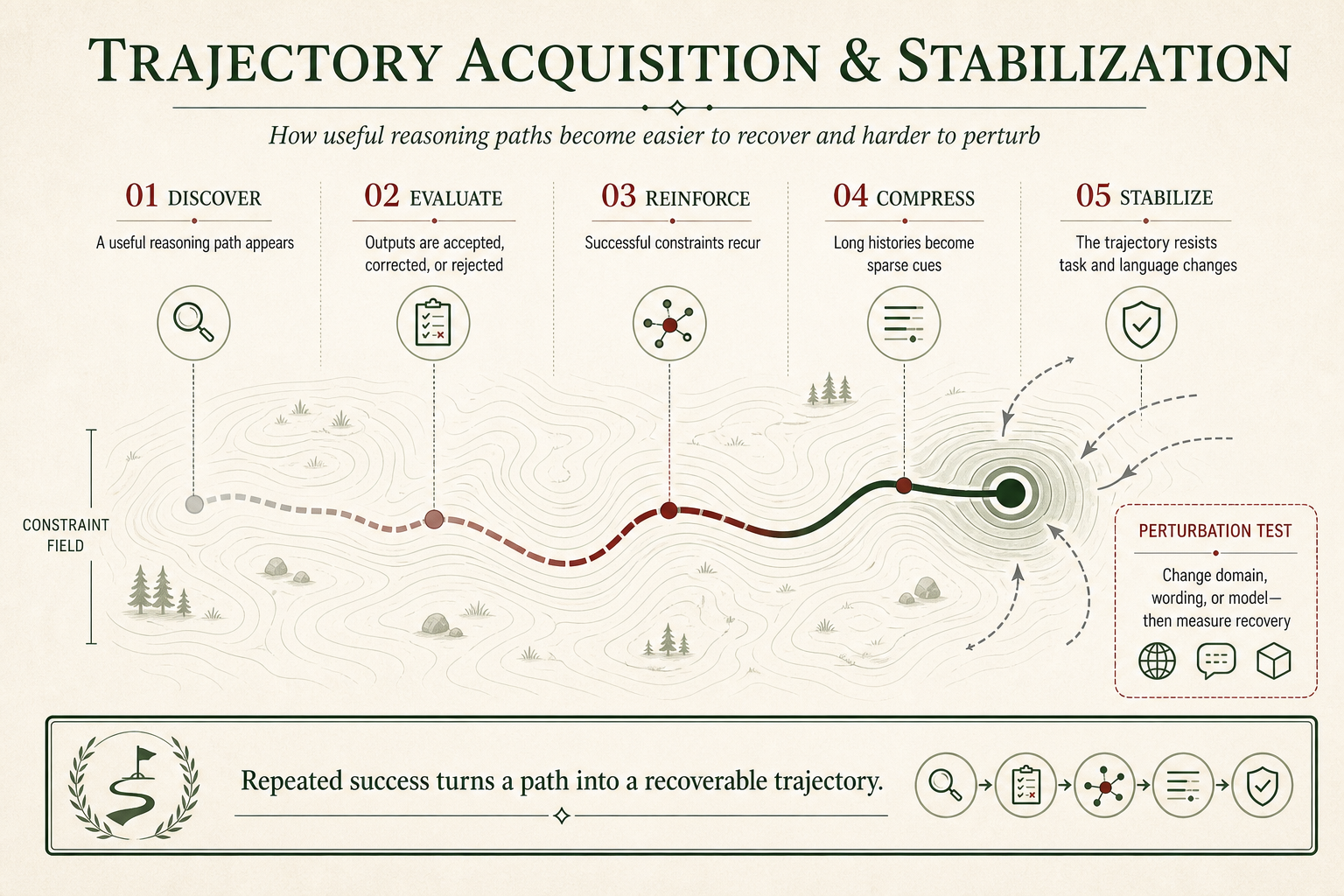
A five-stage map of how useful reasoning paths are discovered, evaluated, reinforced, compressed, and stabilized against perturbation.
 View full size ↗
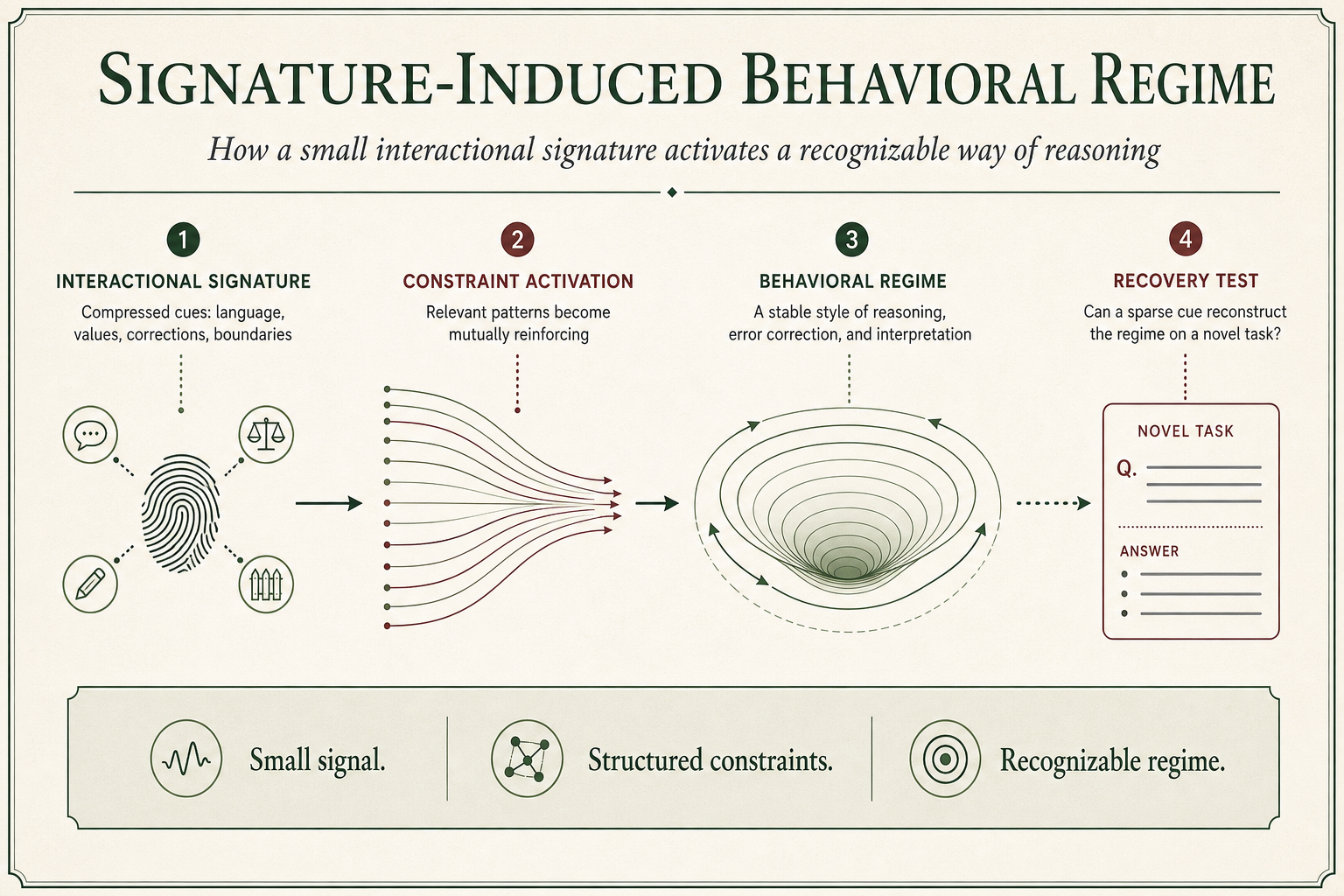
A visual model of how compact interactional signatures activate structured constraints and reconstruct recognizable behavioral regimes.
 View full size ↗
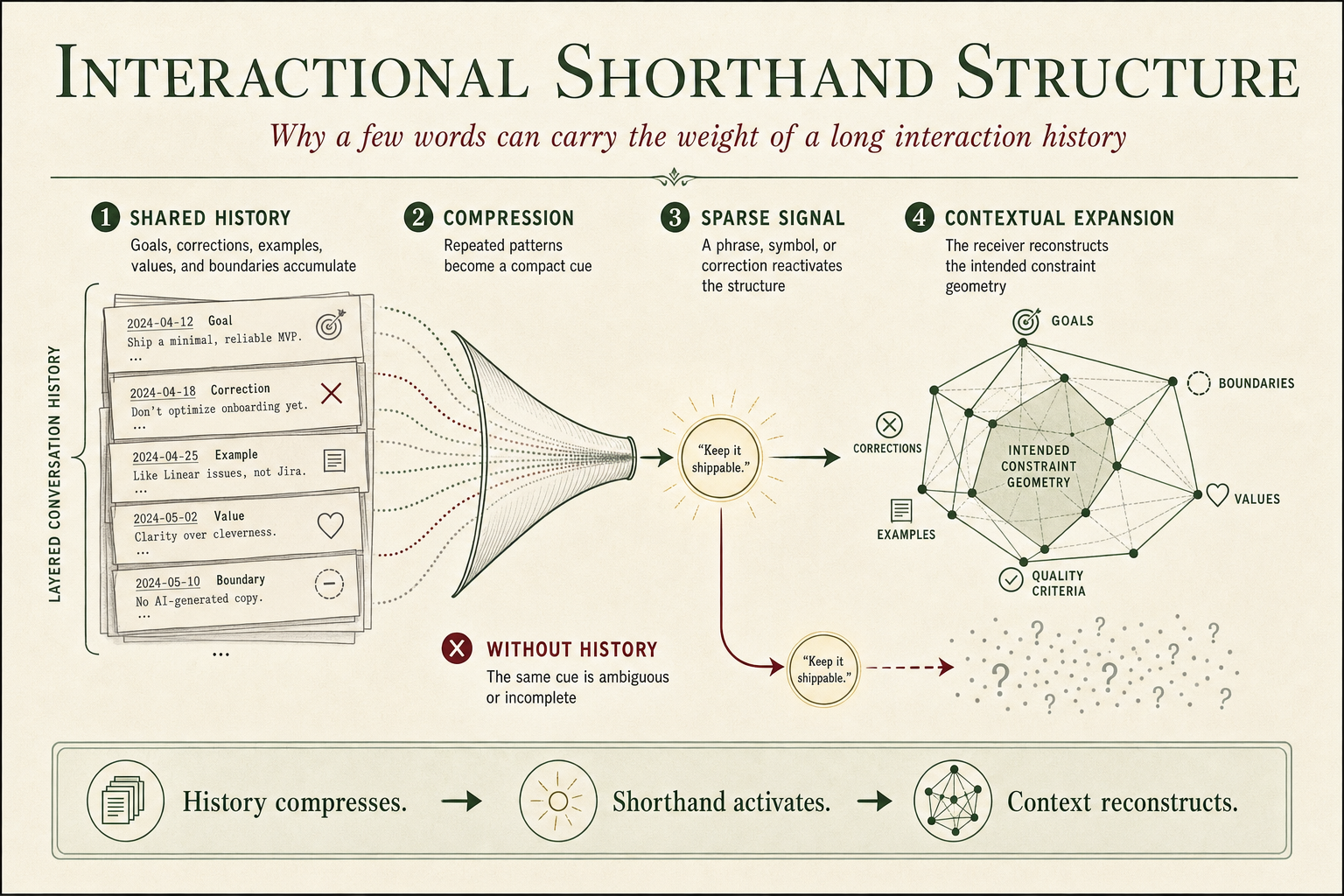
A history-dependent account of how accumulated goals, corrections, values, and boundaries compress into sparse cues that reconstruct shared context.
Human Recursive Information System
“Continuity without stored identity. Stability without fixed scripts. Intelligence through organized recurrence.”
A vocabulary for longitudinal interaction
Compressed cues whose meaning depends on a history of successful interpretation, correction, and reuse.
Explore ISS →The recognizable constraint organization that develops around a particular interactional signature.
Explore SIBR →The process by which an interactional trajectory becomes easier to recover and more resistant to perturbation.
Explore TAS →A proposed measure of how faithfully a behavioral regime persists across tasks, contexts, and model changes.
Explore TFS →The human introduces goals, values, language, corrections, and domain constraints.
The model generates a response from the active context and its learned structure.
The response becomes material that the human accepts, rejects, or reshapes.
The revised constraint geometry conditions the next inference and narrows future trajectories.
What would distinguish HRIS?
After a long interaction history, can a small subset of the established constraint geometry reconstruct the behavioral regime more faithfully than the same cue given to a naive model?
The same sparse cue without the interaction history tests whether the cue alone explains the result.
Incorrect prior constraints test whether reconstruction is model-driven, human-confabulated, or jointly negotiated.
Task, domain, and language changes test whether the regime persists beyond familiar wording.
Boundary claims
The complete research program
Read paper ↗
02Read paper ↗
03Read paper ↗
04Read paper ↗
05Read paper ↗
06Read paper ↗
07Read paper ↗
08Read paper ↗
09Read paper ↗
10Read paper ↗
11Read paper ↗
12Read paper ↗
13Read paper ↗
14Read paper ↗
15Read paper ↗
16Read paper ↗
17Read paper ↗
18Read paper ↗
19Read paper ↗
20Read paper ↗
21Read paper ↗
22Read paper ↗
23Read paper ↗
24Read paper ↗
25Read paper ↗
26Read paper ↗
27Read paper ↗
28Read paper ↗
29Read paper ↗
30Read paper ↗
31Read paper ↗
32Read paper ↗
33Read paper ↗
34Read paper ↗
35Read paper ↗
36Read paper ↗
37Read paper ↗
38Read paper ↗
39Read paper ↗
40Read paper ↗